beginners project

Twistie Stick Snake Carving by Lora Irish

Twistie Stick Snake Carving Free Project

Free Lora IRish Cane Carving ProjectHi Gang!

I thought I would share a walking stick carving.

Day 1 Twistie Stick Snake Cane Carving
Day 2 Twistie Stick Snake Cane Carving
Day 3 Twistie Stick Snake Cane Carving
Day 4 Twistie Stick Snake Cane Carving
Day 5 Twistie Stick Snake Cane Carving

Walking Stick Joinery
Walking Stick Wood Species – Harvesting Your Sticks
Walking Stick – Adding Extras
Walking Stick – How to Clamp Your Handle

Free Mountain Man Cane Carving Pattern


Walking stick carving is often one of the first carving projects a new woodcarver tries.  This particular design – a snake wrapped around a Sassafras twistie stick – is a beginner’s level project, but I think that even the advanced carvers here may discover a few fun tricks and tips.

We will work, step by step, through creating the round, establishing the snake, marking and cutting the twist, texture the snake and bark, adding a frog on the top of the stick, and how to add a real honeysuckle vine into the twist.  The cane will be lightly coated with a finished with a linseed oil and turpentine mixture and then dry mounted to your walking staff.

Supplies:

These are the tools that I used, but you do not need these exact tools or exact sizes.  Use what you have.  If you are new, a bench knife, or large chip carving knife, and a basic Japanese set will get you started.  Because we will be creating the pattern directly to the basswood you can make this stick in any length!

Sassafra Twistie Cane and Snake by Lora Irish1 1/2″ x 1 1/2″ x 12″ basswood blank
bench knife or large chip carving knife
v-gouge
3/8″ round gouge
1/8″ round gouge
u-gouge, also called a veining tool
several sizes of fine rasps or rifflers
220-grit sandpaper
1″ wide painter’s tape or masking tape
pencil, for marking the cane
old toothbrush for cleaning
carving gloves
thick terry-cloth towel
sharpening tools
cardboard center from a roll of toilet paper
linseed oil
turpentine
all thread pipe
epoxy glue

walking stick staff – approx. 4′ to 5′ tall, x 1 1/4″ diameter

Sassafra Twistie Cane and Snake by Lora Irish

We will begin tomorrow by rounding-over the basswood stick, establishing the path of the snake, and rough carving the Sassafras twistie area low to reveal the snake’s body.So, go get your knives and carving tools, check them for sharpness, find a basswood cane blank, and join me tomorrow as we begin this fun project.  I’m off to start cropping photos for you.

I will also be posting  this Twistie Stick Snake Cane each day on my favorite carving forums.  Stop by, join up, so that you can post your questions and photos!!!!  Carving forums are like potato chips … just one is never enough … Grin!

FamilyWoodworking.org at Twistie Stick Snake Cane Thread

WoodworkingChat.com at Twistie Stick Snake Cane Thread

And while you wait to get started, visit Roy’s relief Carving Class thread – See our widgets in the right hand nav bar and on both forums!!!!

Lora Irish carving patternswood carving bench knivesI had a question from one of the forums, and thought I would post the answer here too!

In the photo you can see five different bench knife styles – top to bottom – small chip carving knife, large chip carving knife, detailer, short-blade bench knife, and a long-blade bench knife.

I prefer a large chip carving knife as my main cutting knife whether for relief or for 3-d cane carving. My hand is small, much smaller than my husbands. Where the longer handles of the bench knives fit his hand, they are too cumbersome for me. Also, the short blade of the chip knife puts me hand right against the wood during the cut, a bench knife leaves my hand 1″ to 1 1/2″ away from the wood. The third advantage is that the chip knife serves two purposes – one for my regular carving and, of course, for chip carving.

chip carving knifeIf you haven’t gotten a bench knife yet, consider a large chip carving knife. While you are making your purchases also get some of the new self-adhering bandage wraps. You can cut a short – 5″ length – and wrap the handle of your knife to give added grip strength. Cut a longer piece – 12″ – and wrap your tool handles if you have arthritis. It will make the handles thicker for easier gripping as well as pad the handle to minimize the stress on your joints.

Twistie Stick Snake Carving Free Project Read More »

Free Wood Carving Santa Ornament Pattern

free wood carving santa patternI know that August has just begun and that it is still a month before the kids go back to school, but this is the perfect time to start collecting the patterns and projects that you will want to work this fall.

This “Oh So Easy Santa Ornament” is a great beginner’s project and a real quick carve for any advanced carver.  He takes only two carving knifes – a bench knife and a v-gouge.  Make a dozen or more, place them in a basket of straw with a few extra Christmas balls and have them ready and at hand to give away as instant Holiday gifts!


Estimated Carving Time: less than 2 hours

Estimated Painting Time: 1/2 hour

free wood carving santa patternSupplies:

bench knife or large chip carving knife
v-gouge
sharpening tools
1″ x 1″ x 4″ basswood block
320-grit sandpaper
Acrylic craft paints
titanium white
burnt sienna
cadmium orange
deep cadmium red
Acrylic or polyurethane spray sealer
20-gauge copper wire
16-gauge copper wire

free Lora Irish wood carving pattern

Please, check in often as Lora is doing her yearly pattern closet cleaning!  Lots of free wood carving and pyrography patterns are headed your way.

Free Wood Carving Santa Ornament Pattern Read More »

mallard duck wood burning

Fading Wood Burnings

Country Church Wood BurningWith time and age your wood burning and pyrography designs appear to fade into the wood, losing those sharp, dramatic contrasts and very pale tonal values.  Recently, while cleaning our studio, I came across several of my very first wood burned projects, which are perfect examples of how as wood ages it develops a distinct patina which directly affects to look of our wood burning tonal values.
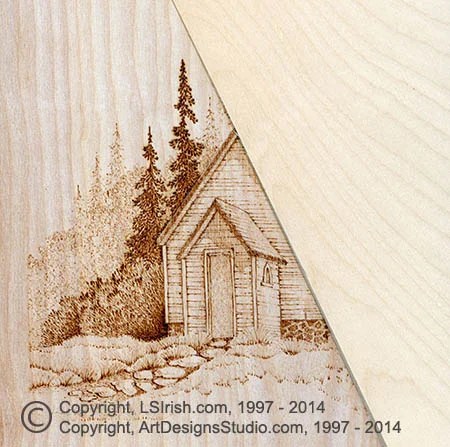
This Country Church, right, was burned in 2004 for the Great Book of Woodburning.  It is worked on birch plywood using a variable temperature burning unit and a looped tip pen.  The image that you see is from the original scan made for this book.

Notice how clean and white the background wood appears.  The burning shows as a neutral dark brown to pale beige hue, and there is a wide range of tonal values throughout the burning.

Country Church Pyrography ProjectHere is a scan, made this morning, of the same wood burning, ten years later.    The birch has taken on a rich pale red hue and a darker tonal value in the grain lines.   With age and time, wood naturally darkens in tonal value, and the results of that darkening process is called patina.

When the wood grain is exposed to air the wood literally begins to rust through oxidation.  The minerals in the natural oils and sap begin to darken into deep orange, red, and rust tones, changing the coloring of both your wood and your wood burning.

In the 2014 scan of this Country Church pyrography you can see the red tones of the oxidized patina.  Because that patina is behind the burned lines and shading of the pyrography work, the burned  design has also taken on a reddish tone.

Since all of us wish for our pyrography projects to last the test of time, at the very start of your next project you need to consider and adjust for the patina that your wood will develop in the years to come.  Sugar pine will darken to a deep, rich orange coloring.  Your fresh white basswood will move into the yellow-beige tones, and the neutral beige of your birch will become a medium rusty-red with time.  Poplar can move into golden-yellow hues and a freshly cut piece of pink-beige mahogany can become almost black-red within a decade or two.

By knowing what patina color your wood will finally develop, you can plan ahead to work your tonal values in the darker ranges to adjust for aging.  You may also need to adjust your pale tonal values.  Notice in the two images, right, that the fine grass in the foreground, just below the church door is beginning to disappear.  The original temperature setting for this grass created a pale burn line that now is close to the patina tonal values of the wood.

Country Church wood burning projectWhile the two burned images, above, may not seem that dramatic, when I do a side-by-side comparison of the ten-year old Country Church burning against a new, fresh piece of birch plywood you can see it’s not the burning that has faded but the wood that has darkened.

You can not avoid a wood developing a darker patina with time, but you can delay it.  Which wood finish you use can change the coloring of the wood.  Oil finishes and some varnishes create a pale yellow cast, polyurethane and acrylic sealers then to be very clear.  Use a sealer that has UV light protection.

Do not hang or display your finished projects in direct sunlight, nor directly near a heat source as the furnace vent or under a high wattage lamp.

Normal accumulation of dirt and oil can added to the effects of aging.  Lightly wash the surface of your projects with a damp, slightly soapy cloth, then rinse with a lightly dampened cloth.  For heavy dirt use Murphy’s Oil Soap.  It’s excellent for both wood burnings and wood carvings.


Fading Wood Burnings Read More »

free applique quilt pattern

Doodle Applique Quilting

We have been working with doodle patterns in our wood burning and pyrography projects this last week.  Today, let’s see what happens when you bring those doodle designs to your favorite applique quilt project.

free applique quilt pattern

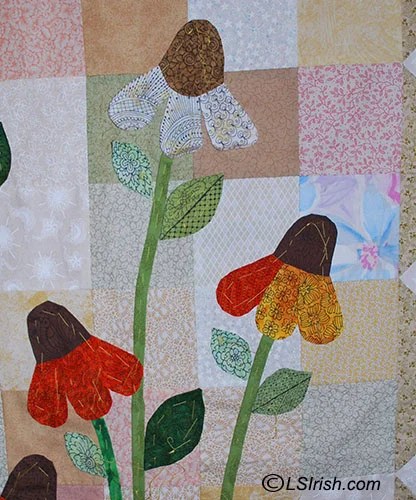
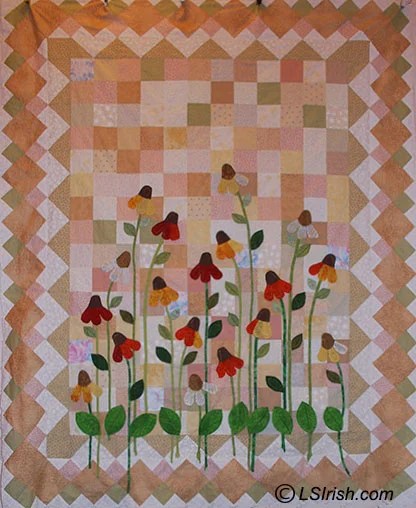
While I have stitched quite a few small applique quilting projects, I have finally started my first full-sized quilt work.  I wanted something fun, something easy, but something extra special since I know I will be working on the quilt top for some time.  I chose a classic, simple wildflower daisy pattern with long stems and lots of leaves over a four patch neutral toned block pattern.

free applique quilt pattern

To add that extra, I chose to get out my fine point permanent marking pen, a variety of tone-on-tone bright cotton fabrics, and the doodle patterns we have been using for our pyrography.  This is a great idea for the quilt top that has been lying around the sewing room because you just didn’t feel it had enough pizzazz to finish.

doodle_quilt_large

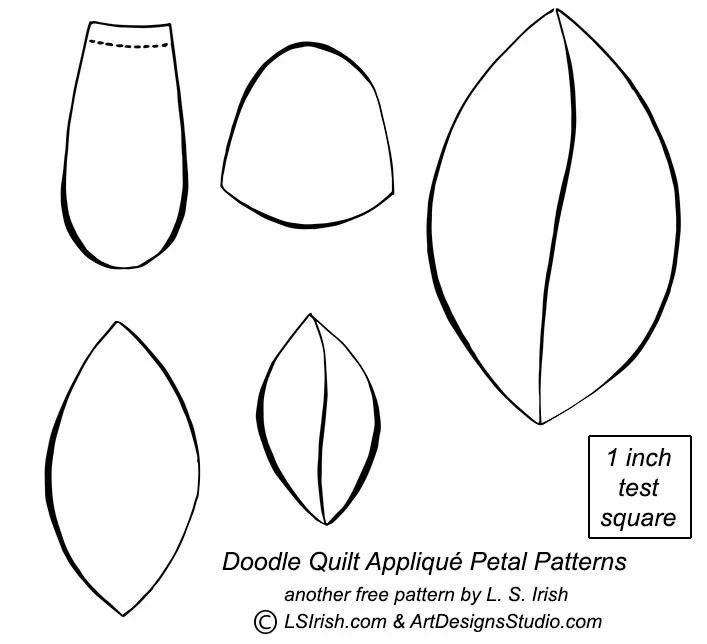
Wash and iron your fabric.  Click and save a copy of the free applique quilt pattern.  Trace a copy of each pattern piece onto the back of a piece of 220-grit sandpaper.  Pin or tack the fabric to a piece of foamboard.  Lay the sandpaper pattern pieces on the fabric and trace around the outer edge with a water-soluble pen, allow space between each pattern piece for seam allowances.

free applique quilt patternClick and save the full-sized pattern above – another free pattern by Lora S. Irish.

Now, using your permanent marking pen, have fun doodling patterns to the fabric.  I chose black for my designs, but also consider using multiple colors for pale toned or neutral fabrics.  When the doodling is done, remove the fabric from the foamboard and iron.  You are ready to move on to your favorite applique technique.  Fun, easy, creative, and a one of a kind show stopper.

For more doodle designs and doodle fill patterns, please see our New Pattern Package – Pyrography Doodles at Art Designs Studio.

Pyrography Doodles Pattern Pack by Lora Irish

Doodle Applique Quilting Read More »

pyrogrpahy doodles project

Pyrography Doodle #7

Today we will put our Mushroom Pyrography Doodle project together to create a desktop note board.  The finished project also makes a great recipe holder for your kitchen.  If you are just joining this project, please follow the links below for the free step-by-step insturctions and pyrography pattern for this free Lora S. Irish wood burning pattern.

Pyrography Doodles
Pyrography Doodles #2
Pyrography Doodles #3
Pyrography Doodles #4
Pyrography Doodles #5
Pyrography Doodles #6
Pyrography Doodles #7

Please drop by our carving and pyrography pattern website, Art Designs Studio, to get your free mushroom pyrography patterns that complement this project.  The pattern package is on our home page.  The links to the previous posts for this free project are below.

Pyrography Doodle Mushrooms Project, step 15Step 15:Finishing Your Project

1. Lightly sand your work using a fine grit nail foam core pad or board. Wipe any sanding dust with a dry cloth.

2. Cut your cork board to 5 1/2” wide x 10 1/2” high, using a sharp craft knife. Round the corners using a jar or bottle lid as your guide.
Cut a sheet of computer paper the same size and shape as the cork. We will use the paper to protect the cork during the sealing steps.

3. Spread an even layer of yellow carpenter’s glue to the back of the cork board. Lay the cork onto your plywood, 3/4” from the right side of the plywood and 1/2” inch from the top – aligning it with the burned design.

4. Lay several heavy books on top of the cork, to apply pressure, and allow the glue to dry completely.

5. Using hot glue, circle the outer edge of the cork board with one strand of sea grass. Begin your gluing at the center of the bottom edge of the cork.

6. Using hot glue, circle the outer edge of the plywood with one strand of sea grass. Begin your gluing at one lower corner of the plywood.

7. Lay the cut computer paper over the cork area of your project.  Thumbtack into place. Use a spray sealer, following the directions on the label, to seal your burning. The computer paper will protect your cork from the spray application.

8. Cut your basswood board to measure 12″ long by 3 3/4″ wide. Draw a diagonal line from corner to corner on the basswood. Using either a small cabinet saw or your craft knife, cut along the line to create two triangles. Sand the cut edge of each triangle piece of basswood. Using yellow carpenter’s glue, glue the triangle supports to the back of the plywood to create legs. Place the basswood legs 2” from the sides of the plywood, with the long diagonal cut edge against the plywood.

Thank you for joining me in this fun pyrography, wood burning project.

Pyrography Doodles Pattern Pack by Lora IrishThat’s it!!!  If you are ready for more great patterns and designs that you can use in your pyrography doodle projects please see our new Lora Irish pattern package, Pyrography Doodles at Art Designs Studio.  This exclusive package includes 300 doodle designs that you can use in your pyrography, 26 carving and pyrography patterns, 10 finished doodle samples, and 3 border patterns.

Pyrography Doodle #7 Read More »

Scroll to Top