free projects

Pyrography Styles – Pointillism

Pyrography is so much more than just outlining your pattern and burning the background to black.  Any art style can be created, using a wood burning tool and your selected pen tips.

Pyrography Styles Handbook by Lora S. Irish, at Amazon.com

Let’s look at Pointillism in this day’s post.

Pointillism, also called Neo-Impressionism, was introduced in the late 1880’s by Georges Seurat and Paul Signac.  There is a great Wiki article on this painting style – read more here.

Pointillism began as a new way to blend colors on a canvas.  Instead of blending two or three colors to create a new color, small, tightly packed dots of the two colors visually created the new third color.  So instead of mixing and blending cadmium yellow with ultramarine blue to create a medium green, a very small dot of yellow was painted next to a small dot of blue.  Your eye then blends the two color dots into the new green tone.

To learn more about Pyrography art styles, please visit Amazon.com for your copy of Pyrography Styles Handbook by Lora S. Irish – Your comprehensive guide to the 7 major styles of woodburning: crosshatching, realism, pointillism, shaded drawing, engraving, silhouette, and texture painting.  LSIrish.com is an affiliate of Amazon.

Watercolor Painting your Wood BurningPlease see our article, Color Wheel or Who is Roy G. Biv?

If a yellow-green was wanted the artist would paint two small dots of yellow next to the blue.  If you wanted a darker green, then the artist used two touching dots of blue with one dot of yellow.

The idea of using dots instead of strokes directly impacts how we as wood burning artists can create a pyrography image.  Where Neo-Impressionists used color dots, we wood burners use heat setting for pale, medium and dark dots, and density to create pale tonal area to almost solid black areas in our work.


Celtic knot pyrography wood burning patternFor more reading on pyrography and wood burning techniques, please see our pyrography navigation menu.

This Celtic Bird Postage Stamp burning is also worked in the Pointillism style, and available for free here at LSIrish.com.  This post includes the free Celtic Bird postage stamp pattern.


The cougar pyrography project will take you, step-by-step, through a fun, pointillism work.

This entire design is worked using only a small dash stroke made with a ball tip or loop tip pen.  How hot the temperature setting is and how densely you pack those dash strokes gives the sepia value range – pale areas, medium toned areas, and black areas.

This post included the free Cougar pattern and is one of the step-by-step projects included in Pyrography Style Handbook.

Posting tomorrow on Silhouette style burnings !!!!


Pyrography Styles – Pointillism Read More »

Wood Carving Free Projects, Lora Irish Books


cane, walking stick, and wizard wand carving
Wood Carving Walking Sticks, Introduction

Wood Carving Walking Sticks – Adding Extras
Wood Carving Walking Sticks – Common Tree Species
Wood Carving Walking Sticks – Harvesting
Wood Carving Walking Sticks, Gluing Your Joint
Wood Carving Walking Sticks, How to Clamp Your Cane Handle
Wood Carving Walking Sticks, How to Join Your Cane Handle
Wood Carving Walking Sticks, Working with Bamboo
Free Mountain Man Cane Carving Pattern


Twistie Stick Snake Carving by Lora Irish

Relief Carving Workshop by Lora S. IrishTwistie Stick Snake Cane Carving, Day 5
Twistie Stick Snake Cane Carving, Day 4
Twistie Stick Snake Cane Carving, Day 3
Twistie Stick Snake Cane Carving, Day 2
Twistie Stick Snake Carving Free Project
Walking Stick and Cane Handle Joinery
Wood Carving Walking Sticks


free walking stick wood carving project
Introduction to Cane Carving

Wildlife Carving in ReliefThe Basic Construction Used In Cane Carving
The Basic Joinery Used In Cane Carving
Adding a Leather String Grip to your Cane Carving


Four Methods to Cutting a Wooden Spoon Blank

Spoon, Fork, and Ladle Styles for Wood Carving
The Art of Spoon Carving by Lora S. Irish
Wood Carving a Basic Wooden Spoon
Styles of Wood Carved Spoons
Welsh Love Spoons
Welsh Love Spoons Introduction
Basic Cutting Techniques
Carving A Chain and Ball
Ball and Cage Carving


Lora S Irish blog Site Map
Wood Carving Fish Decoysfinishing and paintinf techniques for wood

Sun Fish Decoy
Ice Fishing Decoy Gallery Two
Ice Fishing Fish Decoy Gallery


Mule Deer Relief Carving Free Project by Lora Irish
Working in Levels – Mule Deer Relief Wood Carving Project
Shaping the Mule Deer – Mule Deer Relief Wood Carving Project
Wood Burning the Mule Deer Details
Dry Brush Painting – Mule Deer Relief Wood Carving Project


Relief Wood Carving Canada Goose Project
North American Wildlife Patterns for the Scroll Saw by Lora S IrishRelief Wood Carving Canada Goose Project, Part One
Relief Wood Carving Canada Goose Project, Part Two
Relief Wood Carving Canada Goose Project Part Three
Relief Wood Carving Canada Goose Project Part Four


Tiki Chess Set by Lora Irish

Great Book of Fairies by Lora S Irish

Tiki Chess Set, Beginner’s Carving Project


Classic Carving Patterns by Lora S IrishRussian Birch Bark Carving


101 Artistic Relief Patterns by Lora S IrishAltered Art Wood Carving


Wood Carving Celtic Dragon 3
Wood Carving Celtic Dragon 2
Wood Carving Celtic Dragon 1


Chip Carving
Free Chip Carving Wood Carving Pattern
Free Chip Carving Projects by L S Irish
Back to the Basics of Wood Carving
Chip Carving Common Mistakes
Chip Carving – Sampler Layout Pattern
Chip Carved Chess and Game Board
Chip Carving – Straight-Wall, Curve-Wall, Free Form
Chip Carving – Cutting Triangle and Square Chips
Chip Carving Hand Positions and Grips
Chip Carving Graphed Patterns
Chip Carving Supplies
Chip Carving Seminar
Free Chip Carving Pattern
Sharpening Your Chip Knives
Positive and Negative Space in Chip Carving
Chip Carving Shortbread Cookies
Sharpening Your Chip Knives


Carving the Relief Wood Spirit

Wood Grain with Acrylics and Oil Stain
Dry Brush and Rouging the Wood Spirit Face


More Technique and General Instructions


Wood Carving Free Projects, Lora Irish Books Read More »

wood carving a simple flower

Wood Carving A Simple Flower
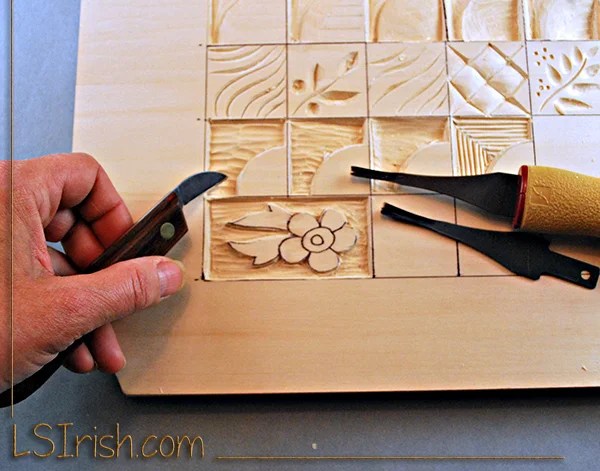
This simple flower wood carving is worked from the practice board project in Relief Wood Carving Workshop by Lora S. Irish.  This practice board, which includes 22 specific techniques for relief wood carving and 3 small flower designs, allows you to learn and explore the cutting strokes each of your wood carving tools creates.


PRACTICE CARVING ONE
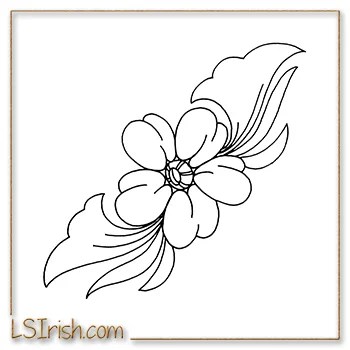
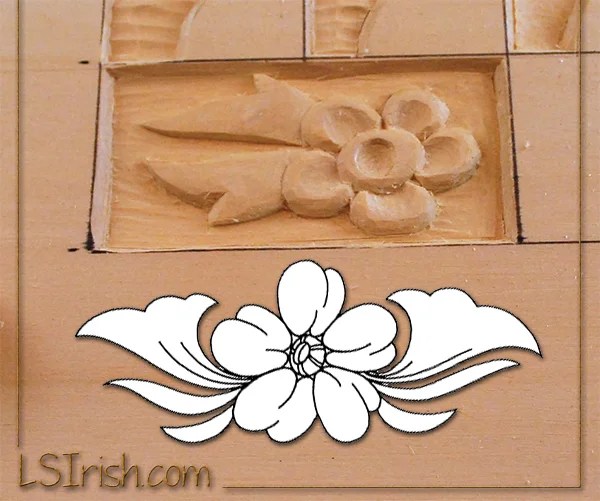
This super simple flower pattern will walk you through many of the basic techniques learned in this practice board chapter.

wood carving a simple flowerStep 1 Trace your pattern to your practice board using graphite paper.


wood carving a simple flower
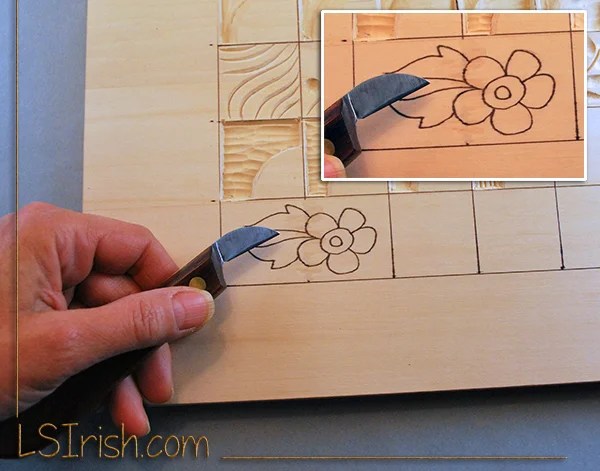
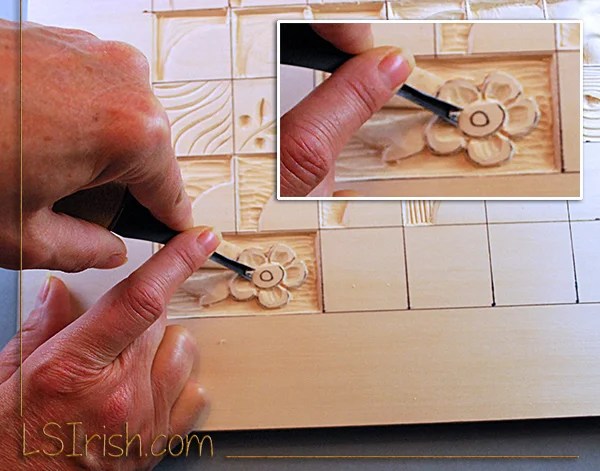
Step 2 Create a bench knife stop cut along the outer edges of the pattern.  Cut triangular chip cuts in the background corners of the petals.


wood carving a simple flower
Step 3 Working with the grain of the wood rough cut the background using a medium round gouge.


wood carving a simple flower
Step 4 Rough cut the background to a depth of 3/16”, making straight outer walls on your design elements.


wood carving a simple flower
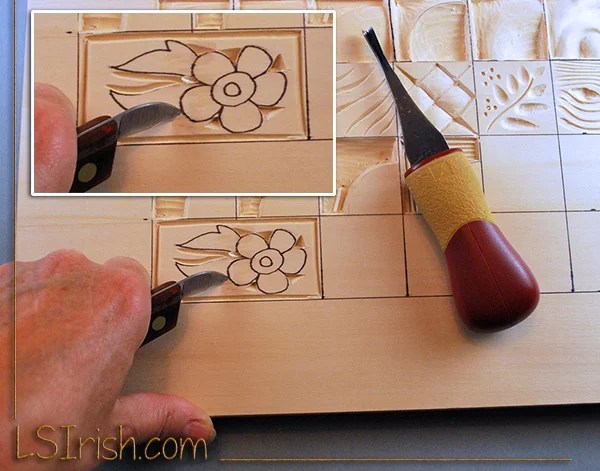
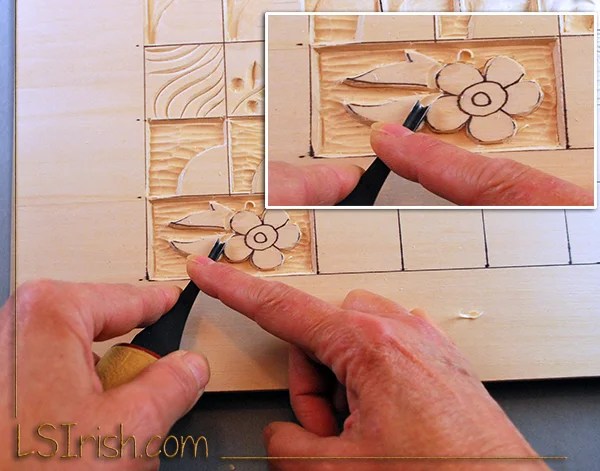
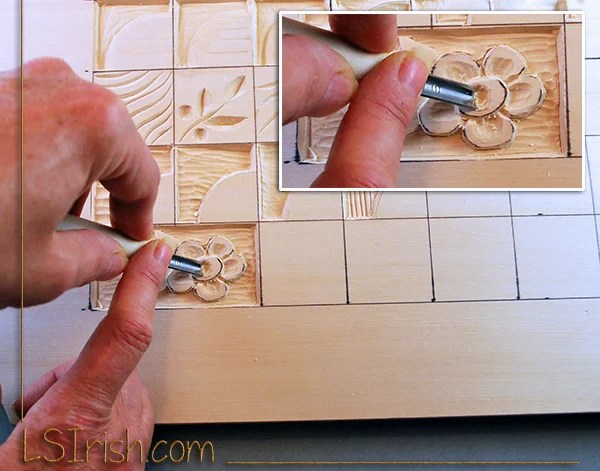
Step 5 Create a stop cut using your v-gouge between the leave elements and the flower petals.


wood carving a simple flower
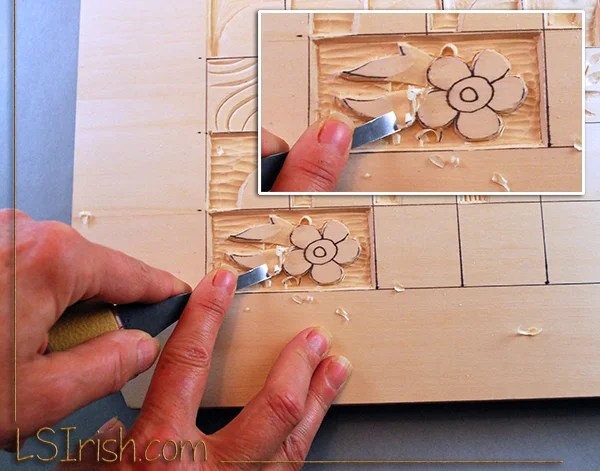
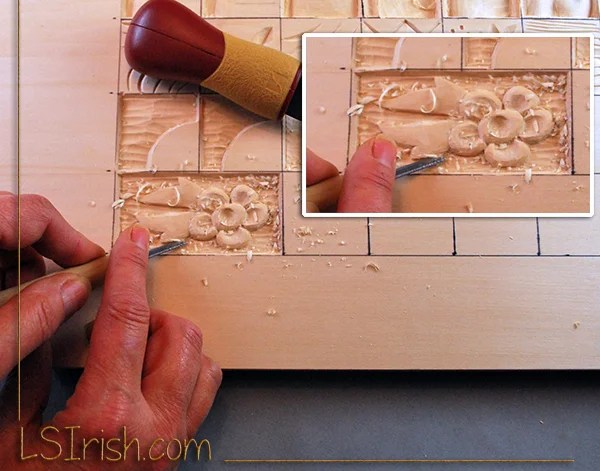
Step 6 Using a straight chisel taper the base of the leaf into the flower petals. Taper the outer leaf point away from the flower. This gives the leaves a convex curve.


wood carving a simple flower
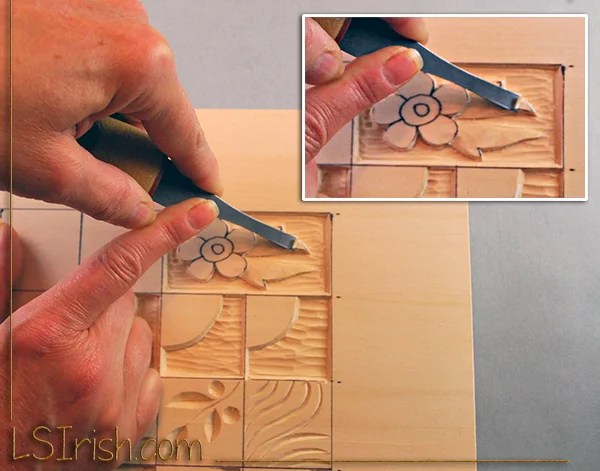
Step 7 Taper the long sides of the leaves towards the background using your straight chisel.


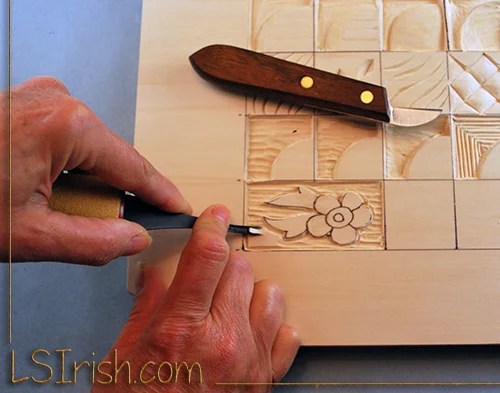
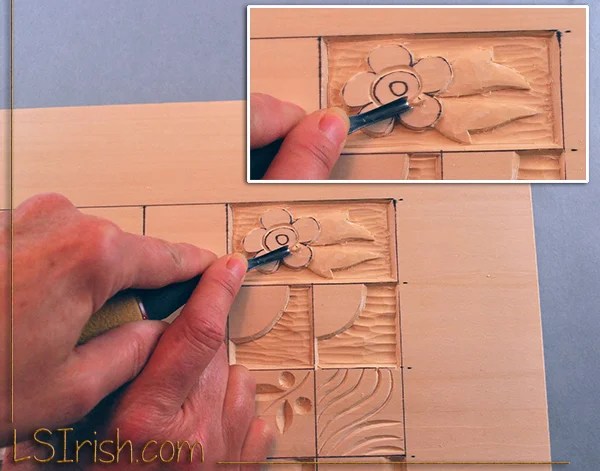
Step 8 V-gouge stop cut the center circle of the flower.


Step 9 Using a medium round gouge or medium u-gouge create a concave indent inside of each petal.


Step 10 Separate each petal using your v-gouge and a stop cut.


Step 11 Up-end a medium or large round gouge to cut the inner circle of the flower center.


Step 12 Using your straight chisel round over the outer edges of the petals.


Step 13 Smooth the carving by shaving each element – leaves, petals, and flower center. Re-cut the intersection joint lines between the elements and the background.


wood carving a wood flower
Step 14 with a few more cleaning cuts and a touch of sanding using 220 grit sandpaper this carving will be completed and ready for either the painting steps or the finishing steps.


Relief Wood Carving Workshop

  • Clear, in-depth instructions
  • Step-by-step exercises
  • How-to photographs
  • 11 original projects for the first time relief carver


Relief Carving the Wood Spirit

With this book any carver can stand beside the workbench of acclaimed artist Lora S. Irish and learn everything she has to teach about creating an expressive wood spirit. Lora clearly explains the relief carving process from start to finish: every cut, every tool change, and every depth check. The entire craft is here, from preparing the wood to roughing out and detailing the wood spirit to applying a long-lasting finish. No step is left out and no technique is left unexplained. The author shares her tips for creating realistic and detailed facial features like eyelids, windswept hair, beards, and the ever-important mustache. Best of all, when the step-by-step project is complete, Relief Carving Wood Spirits, Revised Edition offers 20 more original patterns to keep any carver busy for seasons to come.


Wood Carving A Simple Flower Read More »

Art of Spoon Carving

Beginner’s Wood Carving, Spoon Carving

While getting the Monday, January 7th free doodle patterns post ready I came across all of these links on wooden spoon wood burning, and wooden spoon wood carving.  Since I had them all in one place I thought I would share them with you.

If you wood burn wooden spoons I think you might have some fun learning how to wood carve your own.  Basswood blanks are a great wood to start your spoon carving journey.  As your carving skills grow you can then move onto poplar, maple, and beechwood – all of which burn well.

If you are a new wood carver there is nothing more fun than creating your own kitchen spoons.  Anything goes from the classic straight handle oval-bowled spoon to intrigue Welsh Love spoons, even modern twisted handle pouring ladles.  Spoons are one of those ‘guaranteed’ success projects.

Links to Basswood Sources:

Heinecke Wood Products!    *** A favorite site for me

The Carving Store   ***  Ebay, This is a go-to source for pre-cut rectangle and square blanks.

B W Hobbies   *** Ebay, offering long basswood boards

petersapienza   *** Ebay, offered pre-cut spoon blanks


free Lora S Irish free spoon carving patternLinks to Wooden Spoon Projects on LSIrish.com

Back to the Basics of Wood Carving

The Art of Spoon Carving

Wood Carving a Basic Spoon

Styles of Wood Carved Spoons

Forks, Spoons, and Ladle Wood Spoon Carving

The Art of Spoon Carving


Art of Spoon CarvingCarving and Burning a Wooden Spoon In-Depth Project

Cross-Crafting Seminar Introduction

Cross-Crafting Seminar Supply List

Cross-Crafting Seminar Free Patterns

Cross-Crafting Seminar, Scroll Saw Basics

Cross-Crafting Seminar, Setting Up Your Scroll Saw

Cross-Crafting Seminar, Scroll Sawing the Wood Spirit Face

Cross-Crafting Seminar, Wood Burning the Wood Spirit Face

Cross-Crafting Seminar, Colored Pencils for the Wood Spirit Face

Cross-Crafting Seminar, Cutting a Wooden Spoon


Cross-Crafting Seminar, Carving a Wooden Spoon

Welsh Love Spoon Carving and Free Pattern

Free Doodle Pattern 028
Free Doodle Pattern, Extra 003
Free Doodle Pattern, Extra 002


Beginner’s Wood Carving, Spoon Carving Read More »

How deep do I carve a relief wood carving?

Good morning Scot and Marsha!  Thanks for the great conversation yesterday.  Here are the PDFs that will help you learn how to determine how deep each level or layer is in your relief wood carving.

While today’s blog topic is about levels and layers in relief carving, the same information can help you as a pyrographer determine the shading levels and layers in your wood burning.  So, please snatch a copy of the these free PDF files and take time to read through the linked projects here of LSIrish.com.

Free Doodle Patterns, Extra 001

How deep do I cut each level or layer in my pattern in a relief wood carving?

The depth measurement you need for each level or layer in your relief carving depends on several factors.

1. What species of wood are you carving.  Hardwoods as black walnut or maple can stand deeper carved levels than soft woods as poplar and basswood.  The hardness of the wood – how tightly packed the wood grain rings are – helps to avoid excessive cupping and warping.

2. How thick is your wood blank.  You can, of course, carve deeper into a 2″ thick wood blank than you can into a 3/4″ board.

3. How large is your carving blank.  A small blank, 8″ x 12″, is less likely to develop excessive warping than a large blank, 20″ x 32″.  The longer the grain lines in your blank the more likely they are to cup over time.

Free Doodle Patterns, Extra 004

4. What style of carving will you be doing. A simple round-over edge relief carving can be worked fairly deep into the wood, past the one-half thickness rule of thumb.  Since all of the wood grain in a round-over carving is adhered to the wood below it the chances of cupping is reduced.  If you are working an intense under-cut relief carving, you will want to stay above the one-half thickness rule of thumb.  Undercuts create free hanging shelves of wood that are easily effected by the changes in the wood grain of the entire blank.

General Layer Measurements Rule of Thumb!

In general you want to use the top one-half of the thickness of your wood for your carving area.  This leaves one-half of the thickness below the carving to stabilize the board from excessive warping and cupping.  So a board that measures a true 1″ thick can be carved to a 1/2″ depth.

In general your pattern will have three distinct layers – foreground, mid-ground, and background.  Plus it will have one main focal point – a barn, a duck, a dragon.

Free Doodle Patterns, Extra 005

1. Determine in which layer the main focal points falls as this will become your thickest layer.

2. Divide the carving thickness of the wood blank by 4.  This equates to two thickness for the layer that holds your focal point, and one each thickness for the other two layers.

3. So on a 1″ thick board, you will be carving 1/2″ deep.  Divide the 1/2″ by 4 equals 1/8″ per layer.  That’s 1/8″ for the foreground, mid-ground, and background.  Now add the extra 1/8″ to the level or layer that holds the focal point, making it a 1/4″ thick layer.

4.  An example is a barn scene where there is a fence line and mail box in t he foreground, a bank barn with silos in the mid-ground, and a tree line and second fence in the background, worked on a 1″ thick board.  The focal point of the pattern is the bank barn in the mid-ground level.  This equals 1/8″ for the foreground mail box layer, 1/4″ for the bank barn mid-layer, and 1/8″ for the background tree line.

5.  The fourth layer or level is called the sky area or sky line.  This area of carving is usually extremely shallow, a simple 1/16″ rolled-over edge for mountains and trees, and can be carved on the top surface of the remaining 1/2″ thickness of the wood.

Please learn more with these links!

Working with Levels – Simplifying a Pattern into Basic Areas

Simplifying a Pattern into Basic Areas in Relief Wood Carving

Determining The Depth Of The Levels

Levels in Relief Wood Carving

These links will add four more free Lora S Irish patterns to your Artist’s Morgue File!


How deep do I carve a relief wood carving? Read More »

Scroll to Top