beginners project

how to trace your pattern to the wood

How to Trace Your Pattern on to Wood

Preparation – Begin by cleaning, and sanding your wood to create a smooth surface on to which you can transfer your pattern.  Remove all sanding dust using a dusting brush and clean, dry cloth.

Chose Your Tracing Media – There are three primary tracing products which are graphite paper, carbon paper, newspaper, and a soft #4 to #8 artist pencil.

Please share on Facebook and Pintrest!
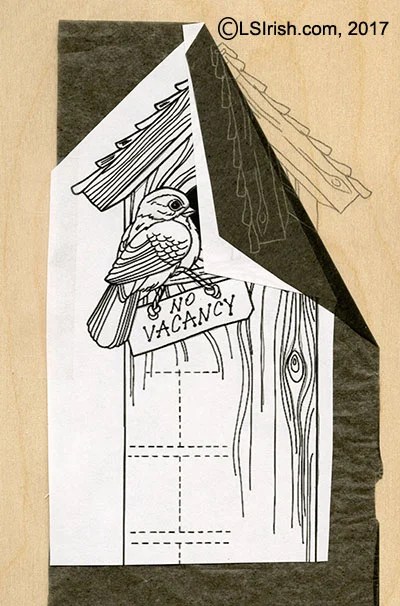
 

tracing your pattern to the wood with graphite paperGraphite Paper Graphite paper can be purchased through both office supply and craft stores.  It comes in several colors, including gray, white, and blue for easy tracing onto different colors of wood.  Graphite leaves a very fine line on the wood and can be erased with a white artist eraser after you have completed your project.
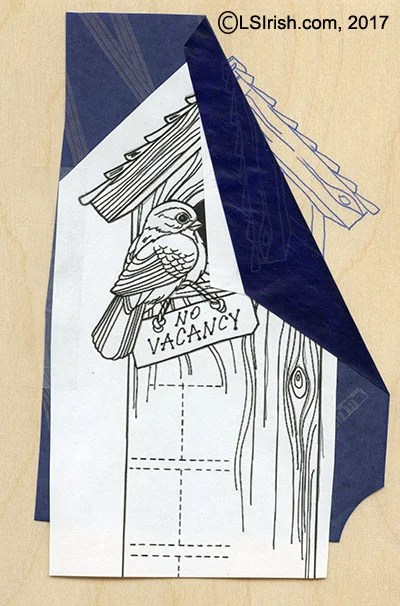


how to trace your pattern to the woodCarbon Paper Carbon paper comes in 8 1/2″ x 11″ sheets and has a very dark, heavy layer of tracing media on the back surface.  It is available in deep blue and black colors.  Carbon paper lines do not erase easily and should be carved or scraped away as your work your project.  Use this media on projects that will receive excessive handling or for long-term projects as it holds up very well.  Because carbon paper was primarily used with typewriter to create multiple copies, you may need to do a little searching to find it.
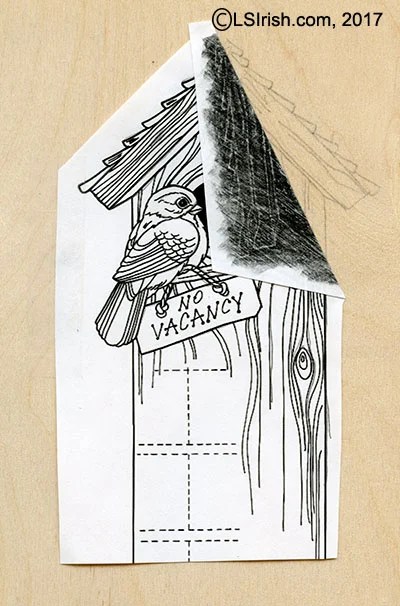


how to trace your pattern to the woodPencil Rubbing – My favorite way to trace my pattern to the wood is to rub the back of the pattern paper with a #4 to #8 artist pencil. This creates a layer of graphite that will easily transfer to the wood surface as your copy the pattern lines with an ink pen.  Pencil rubbings work extremely well for wood, gourds, and even leather.  Woodless pencils work wonderfully for tracing.


Newspaper – Heavily printed sheets of newspaper works wonderfully as a tracing media.  As you trace along the pattern lines the printer’s ink from the newspaper will leave a dotted line on the wood.  This process is especially good for extra large projects as out door signs or long, wide mantel boards.  The ink is easily erased with a white artist’s eraser.
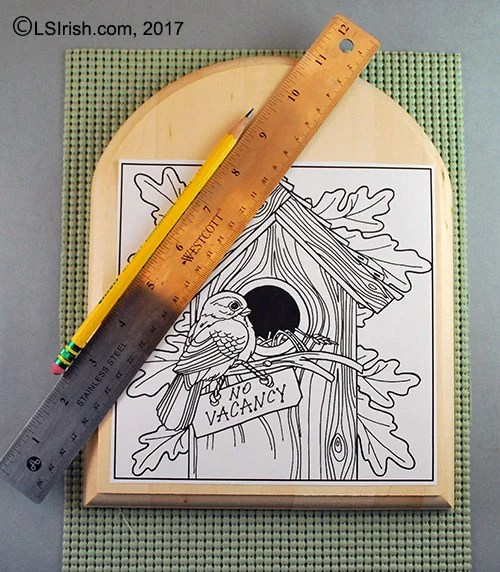
 

tracing your pattern to the wood1.  Adjust your digital pattern as necessary to fit your project piece.  Print several copies of your pattern – one for the main tracing, one for cutting and tracing small areas of the pattern, and one for a reference to the detail lines of the design.

You will need a ruler, a small t-square or right angled triangle, a pencil, painters or masking tape, scissors, and several colors of ink pen.  Of note, my ruler is cork-backed to grip the wood surface and keep the ruler from sliding.
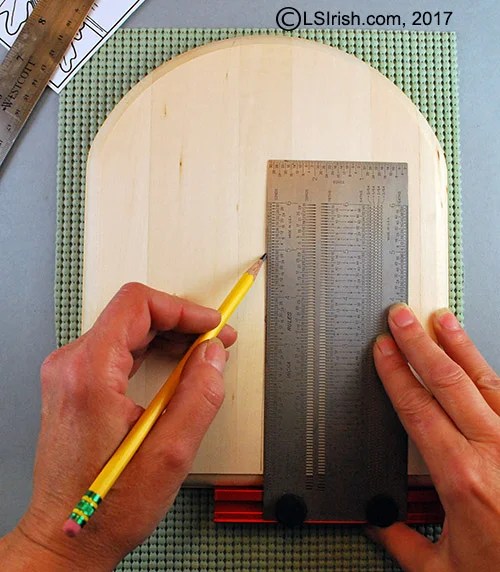
 

tracing your pattern to the wood2.  With a right angle triangle or small t-square mark the center vertical line of your project’s surface.


tracing your pattern to the wood3.  Use your ruler to find and mark the center point of your vertical line.
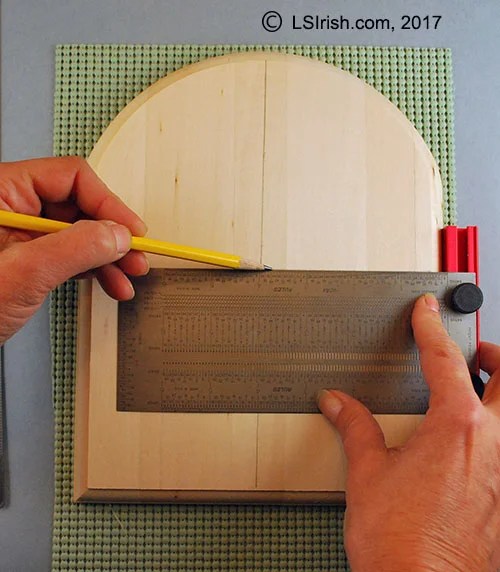


tracing your pattern to the wood4.  With the t-square or right angle triangle, draw a horizontal line across the project surface at the center point of the vertical line.
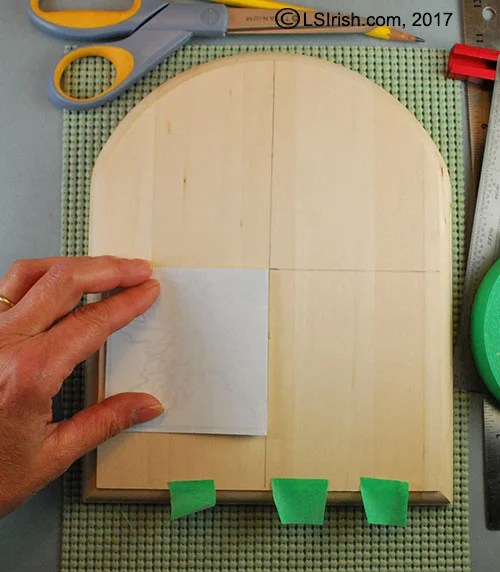


tracing your pattern to the wood5.  Fold your printed pattern into quarters, matching the outer pattern lines on the sides of the pattern. Place the folded pattern on to the wood, aligning the paper folds to the marked lines on the wood.

If you will using a pencil rubbing for your tracing media, open the folded pattern and rub the back of the pattern to completely cover it with pencil graphite.  Refold your pattern and begin the positioning steps.


tracing your pattern to the wood6.  Unfold your pattern, continuing to match folds in the pattern paper with your guidelines.  Cut several small strips of painters tape.  Use the tape to secure two sides of the pattern paper to the wood surface.
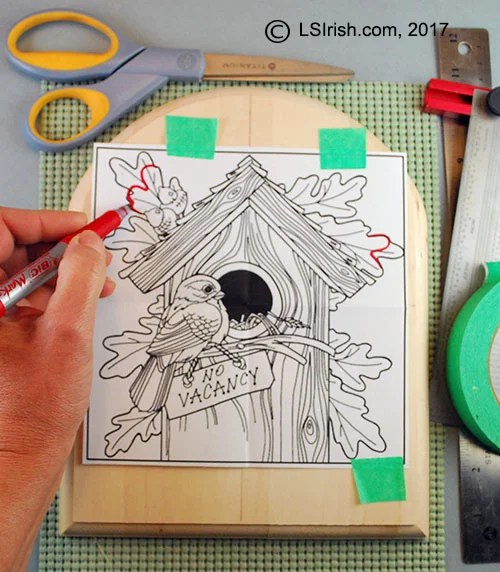


tracing your pattern to the wood7.  Use a colored ink pen to mark any changes you want to make in the pattern, so that you will follow your changes during the tracing process.
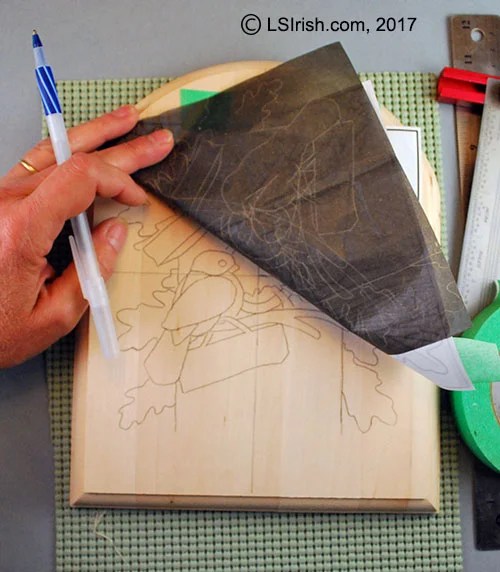


tracing your pattern to the wood8.  Slide your tracing media – graphite paper, carbon paper, newspaper – under the printed pattern with the tracing surface against the wood.  Trace along the pattern lines with a colored ink pen.  Use a light pressure, just enough to transfer the pattern line without leaving an indented score line from the ink pen’s point.  When your tracing is complete lift the pattern paper at one of the un-taped corners.  Check your work before you remove the pattern paper and tape.
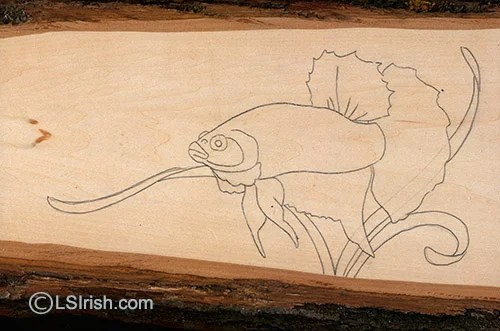


tracing your pattern to the wood9.  Trace only those lines that you really need for your initial working steps.  For my Beta Fish relief carving I needed only the outlines of each area of the fish and the outlines of the grass to work the rough out carving steps.
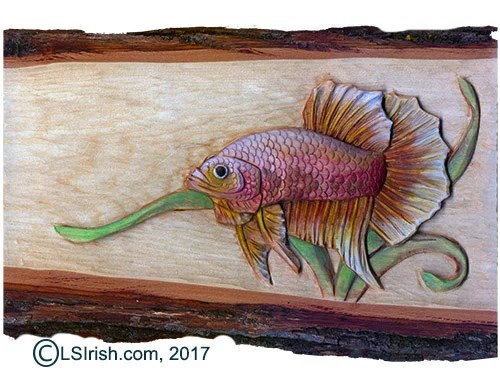


tracing your pattern to the wood10.  When your project work is done, remove any remaining tracing lines using a white artist’s eraser.   Avoid colored erasers that can leave dye streaks on your carving or pyrography work.
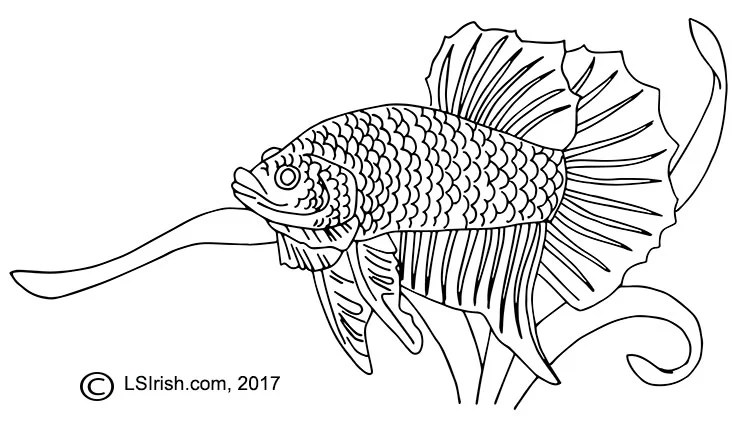


tracing your pattern to the wood11.  Click on the small image on the right for your free full-sized, printable Beta Fish pattern – a design from Relief Carving Workshop, by Lora Irish.
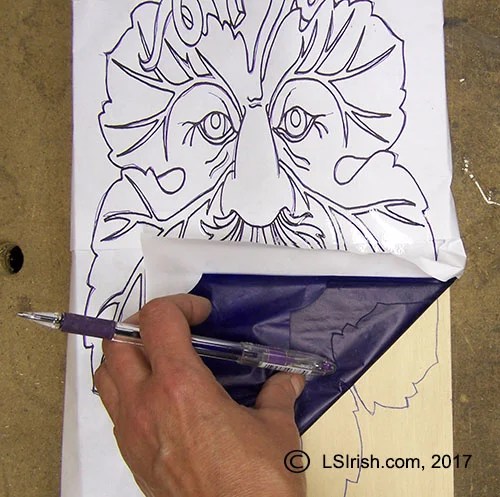


how to trace your pattern to the wood12.  This second example is from the Wood Spirit Carving project posted on the Wood Carving Illustrated Forum.  The pattern was transferred to the wood using typewriter carbon paper because the project would require intense handling.

Relief Carving Wood Spirit Grape Man WIP – Over 250 detailed, close-up photos with step-by-step instructions of relief carving the wood spirit, green man face. This thread has had over 69,000 views!
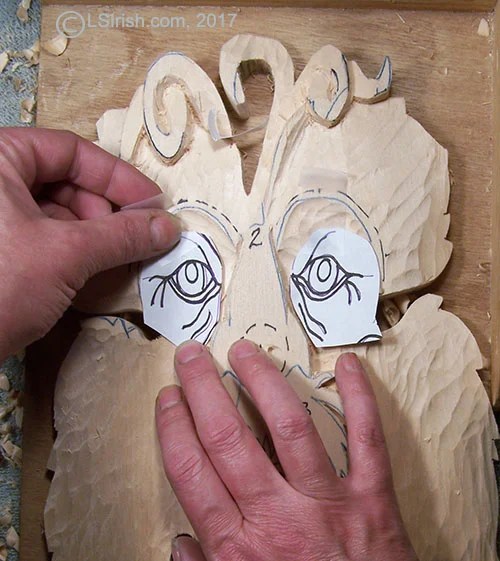
how to trace your pattern to the wood13.  After the levels where established in the carving I cut my paper pattern into small sections that could be easily re-traced to the project.
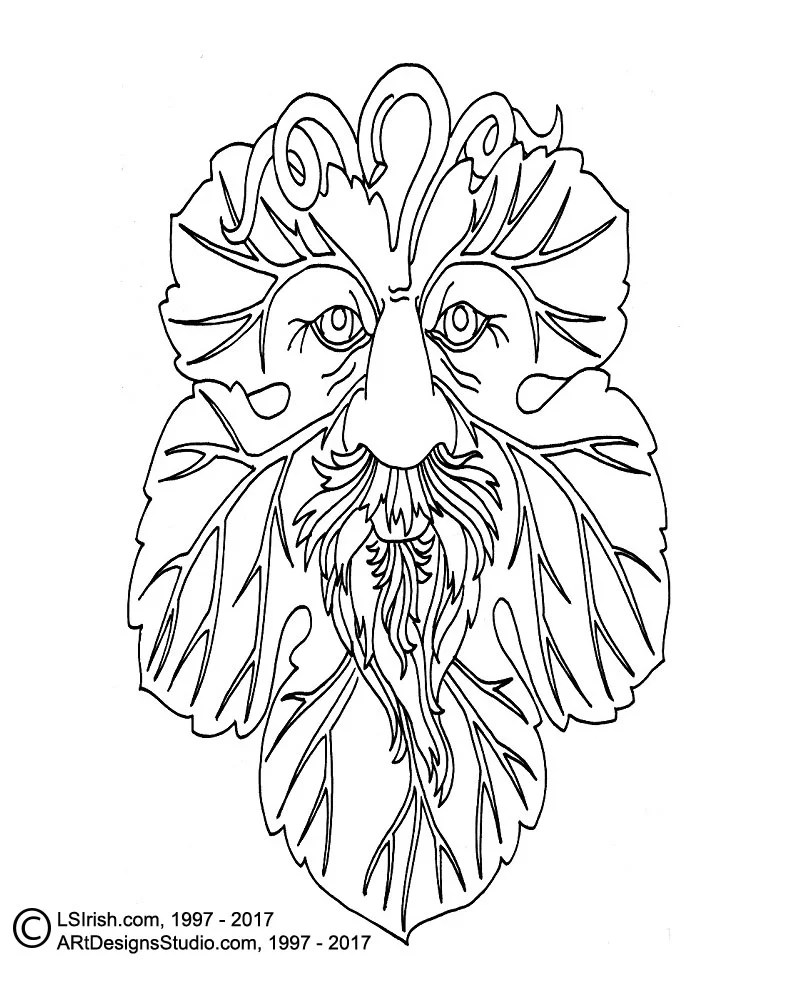


how to trace your pattern to the wood14.  Click on the small image to the right for a free full-sized printable pattern.


How to Trace Your Pattern on to Wood Read More »

color wheel

Colored Pencil Let’s Talk Color

Whether you are a wood carver, a pyrographer, or a gourd artist eventually you will be using color.  Color is part of everything we see and understanding how color works – the basics to color theory – insures that your project is vibrant, vivid, and bold each and every time.

skin colors

Over the next few days we will focus on how the eye sees color v. how the eye sees shadows and light, primary colors v. complimentary colors, and color combinations that create intense skin tones.

So, grab your freebie now and have fun reading through the basics.  Tomorrow we will start a fun, step-by-step Mystic Shaman portrait!

Color Theory by Irish

Colored Pencil Let’s Talk Color Read More »

leather burning by Lora Irish

Leather Burned Jewelry

Step 2 – Creating the Copper Jewelry

Leather Burned Jewelry, Day One
Leather Burned Jewelry, Day Two
Leather Burned Jewelry, Day Three

wire-bent copper jewelry


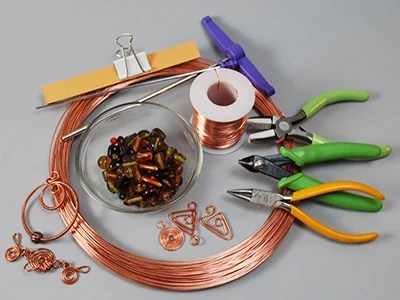
Wire-bent and wire-wrapped jewelry is an art that is currently in high favor among crafters. Jewelry supplies are readily available at most large box craft stores and through online shopping.

For my leather burnt necklaces I chose copper wire and findings, but there is a wide variety of wire types that you can use as silver, silver-coated, black, and colored aluminum. Personally, I prefer copper as it is a soft, easy to bend metal that can be tempered through gently hammering into strong, secure links and chains.

Glass beads and lamp work beads are also a favorite for me in jewelry work, but you will find a wonderful selection of gemstones, cut crystal beads, resin beads, and even bone or shell beads that you can use.


Completing your necklace

1 Cut an 8” length of 18-gauge copper wire with your flush cutters.

leather burned necklace
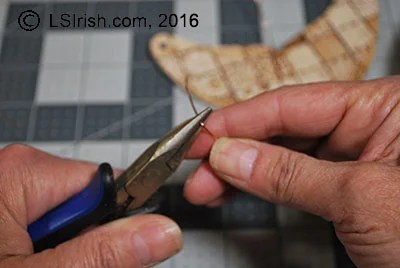
2 Grip the wire about 3” from one end in your straight pliers. Bend the wire to a 90 degree angle. Move the wire to your round-nose pliers, gripping the wire at the 90 degree angle. Roll the 3” end around the round-nose pliers to create a small loop.

leather burned necklace
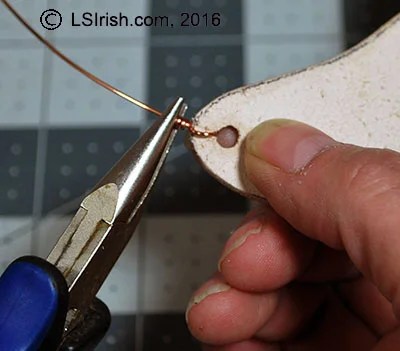
3 Slide the short end of the wire through one of the holes in your leather burnt necklace. Move the wire to center the leather inside of the small loop.

leather burned necklace

Secure the loop

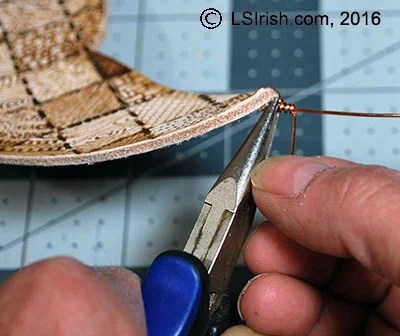
4 Grip the top of the loop, where it overlaps the long working end of the wire in your straight pliers. Roll the short end of the wire around the long working wire two to three times.

pyrography leather jewelry
5 Clip the excess short wire with your flush cutters.

pyrography leather jewelry
6 With your straight pliers crimp the cut end tightly against the long working wire.

pyrography leather jewelry
Adding beads

7 Slide your chosen beads onto the long working wire. In my necklace I used one 2-mm copper bead, one 16-mm square yellow jade bead, and one 2-mm copper bead.

how to make beaded copper jewelry
8 Grip the working wire in your straight pliers, with the tip of the pliers against the last bead. Bend the working wire into a 90 degree angle.

how to make beaded copper jewelry
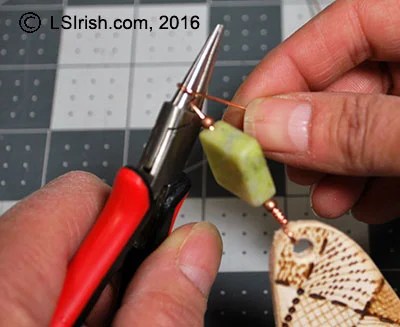
9 Place the 90 degree angle into your round-nose pliers and roll the working wire into a small loop.

how to make beaded copper jewelry

Adding the chain

10 The second small loop should be created by holding the wire in the same spot or area of the round-nose pliers as you did the first loop. This keeps the two end loops of the bead dangle the same size.

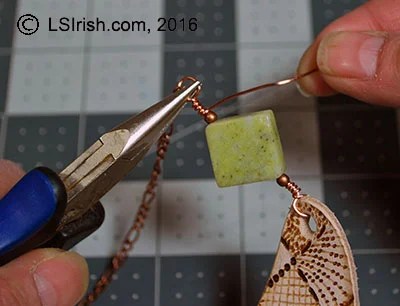
11 Cut two sections of 2- to 3-mm copper chain 7” long each. Slide the last open link of the chain onto the short end of the loop wire. Move the chain link to the center of the loop.

how to make copper jewelry
12 Complete your wire wrapped bead dangles by gripping the small loop in your straight pliers and wrapping the short end wire around the base of the loop two to three times.

how to make copper jewelry

Shaping the leather

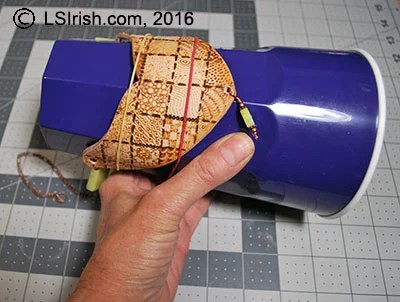
17 Your leather burned necklace can easily be shaped by simply placing your finished necklace under your kitchen faucet for a few moments, allowing the leather to become wet. Pat the leather necklace dry on a clean cloth. While the necklace is still damp and pliable, lay the necklace on a large, plastic soda glass and with loose (oversized) rubber bands lightly secure into place. Let the necklace dry overnight.

shaping leather jewelry

Completed necklace

wood burned leather jewelryIn the next post I will be sharing five more ideas for this leather burned necklace project, with the free patterns.  But here is a preview …

leather burned jewelry by Lora Irish

Leather Burned Jewelry Read More »
Marking Pen Quilts

Marking Pen Quilts

I have a great email question hit my inbox this morning and thought I would share my answer here.

“What brand of assorted color selection of permanent marking pens & fine point black permanent marking pens did you use.  I need pens that do not bleed on quilting cotton, specifically a black pen.  I am want to do a Dalmatian Puppy Quilt and need to permanently colour the black spots on to a white quilting cotton.”

Memory Quilt Project

A Memory Quilt is a fantastic way to record special events, special dates, and special loves that are important to you. They are easy, and quick to create using permanent marking pens!

Memory Quilts can become a project for your entire family or friends by holding a Quilting Party.  Make up the large white squares with the pattern and doodle fills completed.   Then put the squares out of your table with a pack of assorted fine point pens so that everyone can add their own drawings, signatures, or little sayings.  After the event, simply finish the quilt, memorializing the event.

marking pen quilt

My Memory Quilt came about because my son ask me what the name of one of our past cats was … “the one that was marmalade colored with three white paws?”  That started the ‘how many pets have we had in our 42 years of marriage’ naming contest that evening.  The list became so long that I finally had to write the names down so that we didn’t miss any of our beloved friends and didn’t start repeating names.

(While you may know me as a pyrographer and wood carver, my neighbors know me as ‘that cat lady!’   But I plead not guilty as a cat hoarder as all of our friends through all of our marriage have been spayed, neutered, and had their regular vetting and pet vaccinations!  Besides, the biggest pride I ever had at one time was 21, as we somehow ended up with three stray Mommas that wandered onto the back porch, which, of course, came pregnant!!!  And THAT wasn’t my fault.)

So, in answer to the email question, I personally use Sharpies!  They come in both fine point and wide point with a nice variety of colors.  The pens are very reasonably priced and available just about everywhere.

This marking pen quilt is a new creation for the Great Book of Floral Patterns that is in the process of being revised – and which sadly appears to be currently out of print from the publisher.

The quilt is worked on 12 1/2″ white cotton squares.  I printed my patterns, from our Wood Flowers Circle pattern pack, onto regular computer paper.

marking pen quilt

Next, I taped the printed pattern to my light box and over the pattern positioned my quilt square.  The quilt square was also taped to my light box using blue or green painter’s tape, which does not damage the seam allowance of the fabric.  When I turned on my light box, the pattern was extremely clear and visible through the fabric so that I could easily trace the outlines of the pattern with a fine point black Sharpie.

And … as I just wanted this quilt to a fun project I used some of my pyrography fill and texture patterns to fill in each area of my design with the same marking pen.  See our project, Pyrography Doodles, for fill ideas or you may want our Pyrography Doodles pattern package that has over 300 texture and fill patterns, plus 29 pattern designs.

If your white cotton fabric is thin or heavily starched you may have some slight bleeding.  Generally, that bleeding is some minimal that it is not really noticeable once the entire quilt is finished.

When I had all of the large quilt squares completed, I set the marking pen with a hot steam iron.  Next, I used my assorted color pack of fine point Sharpies to write the names of all of our furry friends over the years onto the blank areas of each square.  Since I know that we will have new friends join our family in the coming years, I have plenty of space to add their names too!

Next, I cut 2 1/2″ squares from a series of black and white fabric to become my small quilt squares.  Right now my quilt is waiting for the batting, backing, and free motion quilt stitching.

marking pen quilts

T-shirts are wonderful for marking pens too!  This is an extra-large, 100% cotton t-shirt that has been colored using fine point Sharpies.  The pattern comes from our Celtic Dragons pattern pack.

Marking Pen Quilts Read More »
Wood Carving a Wooden Spoon

Carving a Wooden Spoon

wood caving the wooden spoonThe classic wooden spoon may be the easier beginner’s wood carving project there is.  During this session of our free, summer cross-crafting seminar we will work through the wood carving steps to shape the handle and bowl of a wooden fork.

Cross-Crafting Seminar Introduction
Cross-Crafting Seminar Supply List
Cross-Crafting Seminar Free Patterns
Cross-Crafting Seminar, Scroll Saw Basics
Cross-Crafting Seminar, Setting Up Your Scroll Saw
Cross-Crafting Seminar, Scroll Sawing the Wood Spirit Face
Cross-Crafting Seminar, Wood Burning the Wood Spirit Face
Cross-Crafting Seminar, Colored Pencils for the Wood Spirit Face
Cross-Crafting Seminar, Cutting a Wooden Spoon

Cross-Crafting Seminar, Carving a Wooden Spoon

Supplies:

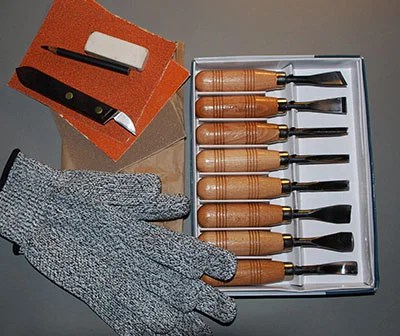
1 – scroll saw cut wooden spoon, slotted spoon, or fork blank
wide sweep round gouge
narrow, half-circle, bent round gouge
bench knife or chip carving knife
carving gloves, thumb guard, or heavy terry cloth towel
150-, 220-grit sandpaper
6″ or large square of brown paper bag

wood carving a wooden spoon

Note: Working with the wood grain


wood caving the wooden spoon
As you work through the carving steps for this wooden fork you will need to pay close attention to the wood grain direction in each area of your work.  Both the handle and bowl of your wooden spoon are curve-shaped.  This means that at the widest point in the curve the direction of your cutting strokes must be reversed to work the knife or gouge blade with the grain. The grain direction of your wooden spoon blank determines the directions of your bench knife and gouge strokes.  You want to move the knife so that it runs with the open fiber ends of the wood grain, not into those open fibers.

Step 1: Rough-cut the edges of the handle along the back of the spoon.

wood carving a wooden spoon

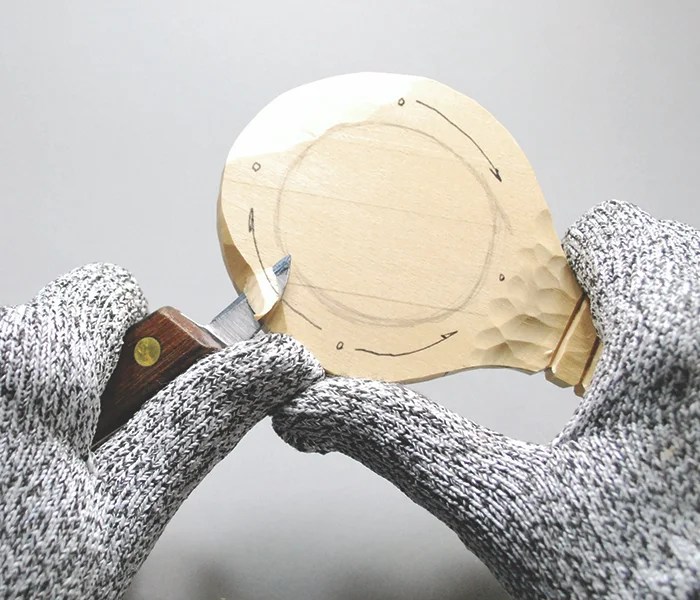
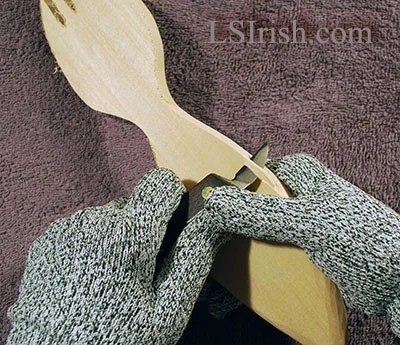
Begin with your bench knife and using a paring stroke, pulling the knife blade towards you, round over the back edge of the lower section of the spoon bowl.  I am using carving gloves in these photos.  Gloves are cut resistant not cut proof!  So, please, watch carefully how you are holding your knife and where the knife blade will go if the knife slips out of the cut.  Often, I carve using thumb guards instead of gloves as they give me more movement in my hands.  If you have neither, use a thick terry-cloth towel in your holding hand as protection.

Step 2:  Rolling small cut strokes along the edge of the handle.

wood carving a wooden spoon
The sides are round by making many, small paring strokes, worked from the inside area of the handle, moving each new cut slowly towards the edge of the handle.  This first series of rounding paring cuts is worked from the center point of the handle towards the top edge of the handle.

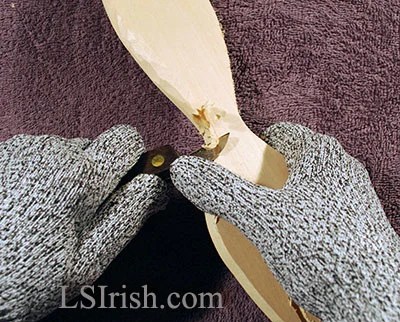
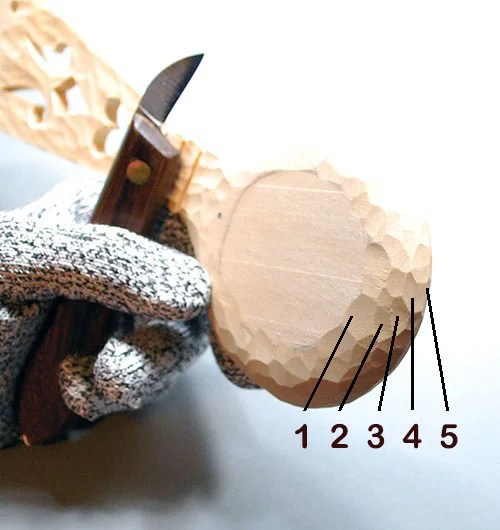
wood carving a wooden spoonYou can see the progression of small cuts in this photo. Using a series of small cuts, worked from the center back towards the spoon’s edge creates a true curved edge instead of a lightly rounded sharp corner.

Step 3: Round over the second lower edge of the back of the handle.

wood carving a wooden spoon

Continue working the lower edge of the back of the handle by moving your cutting strokes to the second side of the spoon.  The smaller your cutting strokes the smoother the finished edge will be.

Step 4: Work the back handle edge towards the fork’s bowl area with your bench knife.

wood carving a wooden spoon

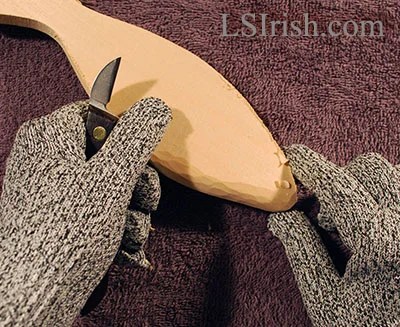
This rounding process is moved to the front portion of the back of the handle.  To work with the grain line of the wood, these cuts are made using a push stroke – pushing the knife blade away from you.

Step 5: Change the direction of your bench knife cuts to match the change in grain direction at the narrow joint between the handle and bowl.

wood carving a wooden spoon

Use a series of short, small bench knife cuts, worked from the center area of the handle towards its outer edge to round over the handle.  Stop your cuts where the handle narrows into the fork’s bowl area, as your wood grain direction will change at this point in the blank.

Step 6: Free the cutting strokes at the narrow joint.

wood carving a wooden spoon
Flip your spoon blank in your hand so that you are working the knife from the fork’s bowl area into the narrow joint with the handle.  This will bring the cuts from step 6 to meet the cuts you are making now, and free those cuts from the narrow area.

Step 7: Finish rounding over the edge of the back by working the fork’s bowl area.

wood carving a wooden spoon
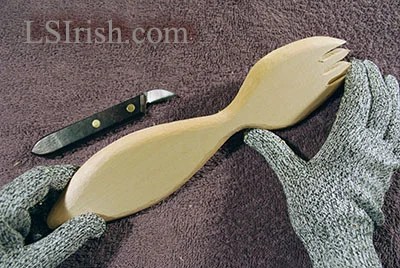
Continue rounding over the back edge of the fork by working the bowl area with your bench knife.

Carving a Wooden Spoon Read More »
Scroll to Top