Today is a “nose to the grindstone – shoulder to the wheel” day of work on the upcoming books from Fox Chapel Publishing. So I am off to work and will post something more substantial tomorrow.
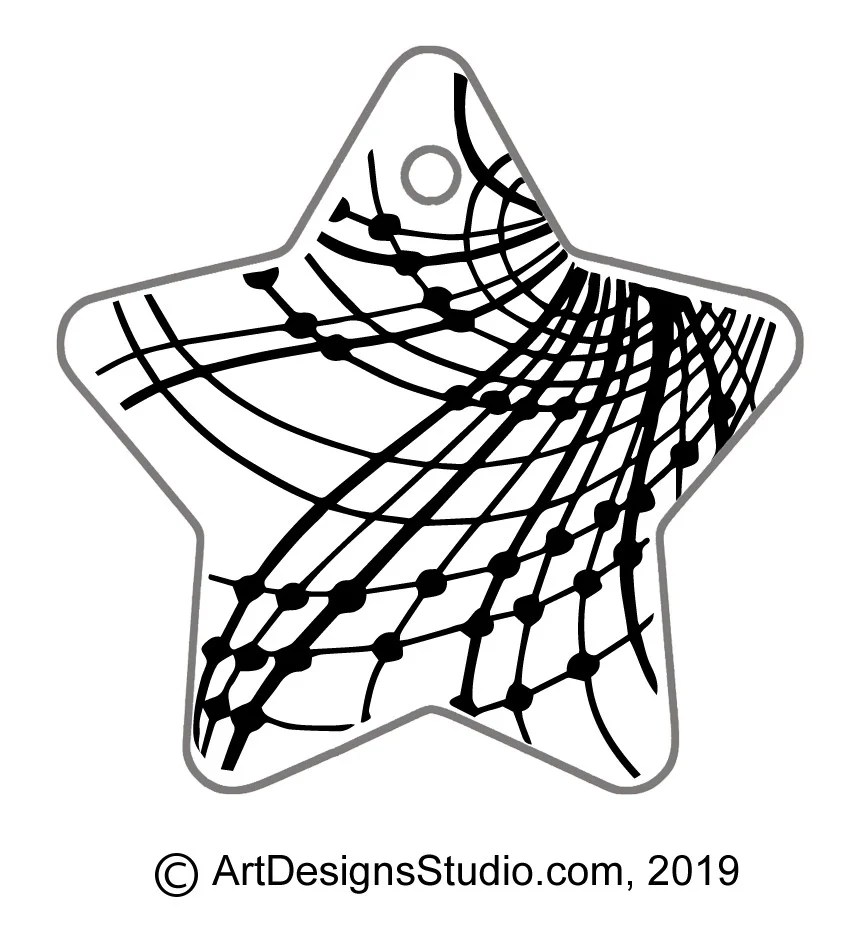
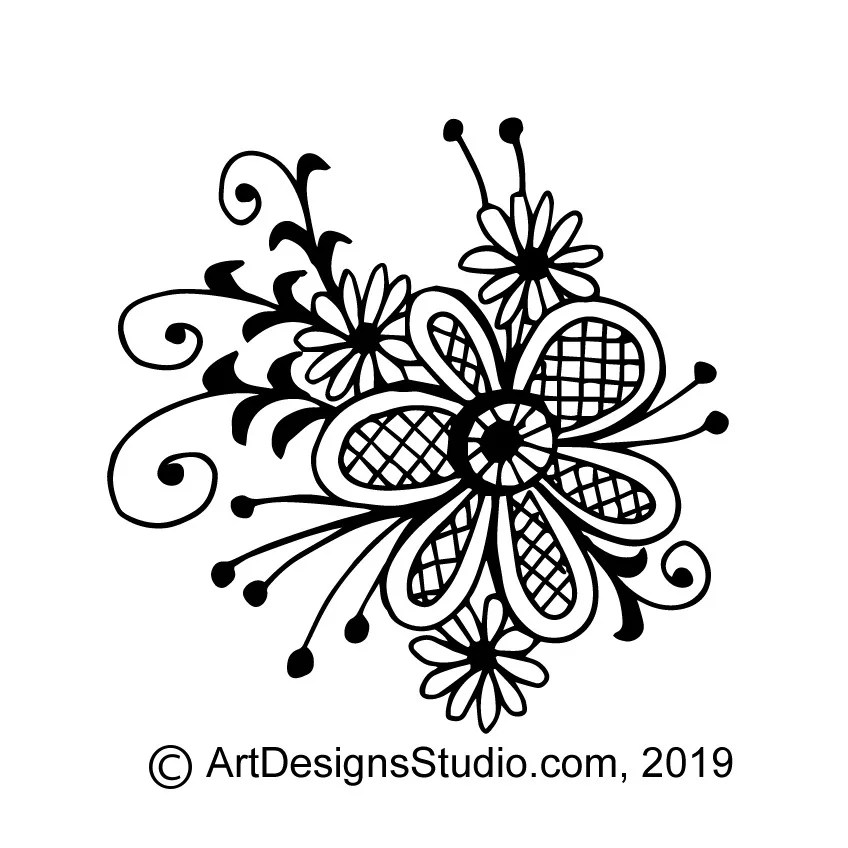
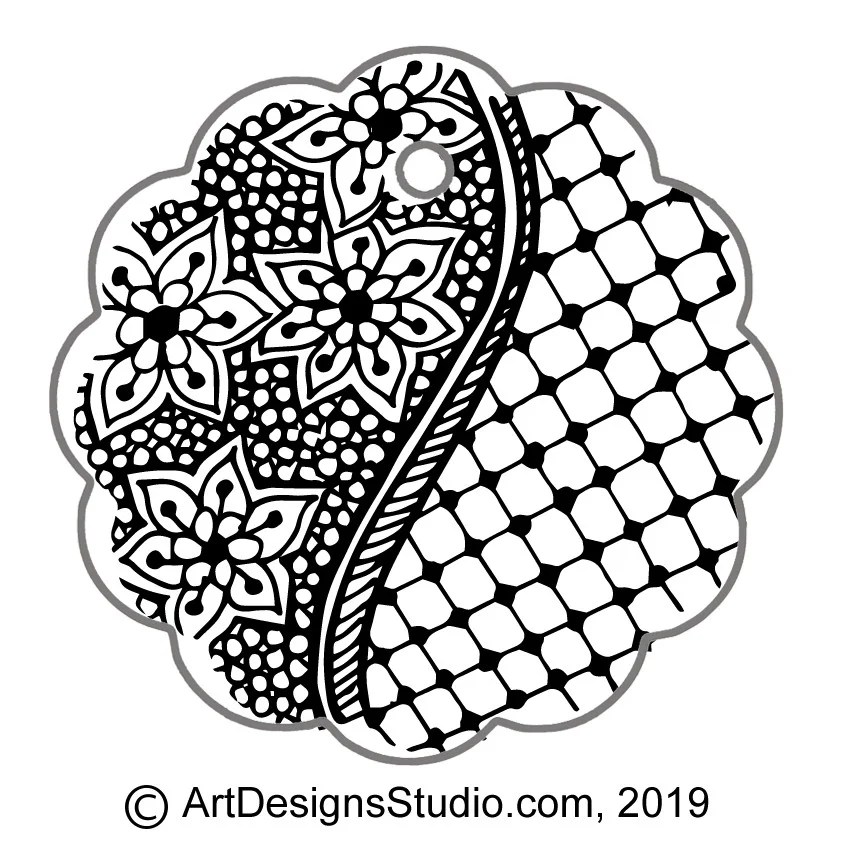
Wooden spoons make great projects for any pyrographer. The small bowls, front and back, of the spoon can become your background for these free doodle patterns.
Most manufactured spoons are made from bamboo, beechwood, birch, or poplar – all woods that are excellent for our wood burning.
Since your pattern work is burned – scorched – directly into the wood the design that you create becomes a permanent part of that kitchen utensil.
Happily as wood burners we are not limited to just spoons. Spatulas, forks, knives, and even rolling pins make great pyrography backgrounds.
Sometimes I love being concise, careful, and controlled in my art … and then sometimes I just want to get down dirty, messy, slimy, anything goes, and hands-on. This String House is one of those ‘dirty up to the elbow’ fun projects from my newest book, Crafting with Gourds.
Introduction
Any natural fiber material can easily be collage to the surface of your gourd using archival white water-based glue. This fun bird house uses paper coffee filters, cotton cheese cloth, burlap, garden twine, and cotton cord to create a riot of texture. When the collage work is dry we will use oil pastels to brightly color the high ridges of the texture.
Preparation
Wash, clean, and cut a 10” high, 8” diameter, 23” circumference kettle gourd following the general preparation instructions.
Supplies
10” high, 8” diameter, 23” circumference kettle gourd
#2 to #6 graphite pencil
wax-coated paper cups
archival white water-based glue
plastic mixing spoon
bowl of water for dipping
large #6 to #12 square brush
latex gloves
coffee filters
cheesecloth
burlap
assorted string, cords, and twine
scissors
Acrylic craft paint
dark brown – bird house
black – mobile
set of 12 to 24 oil pastel sticks
spray sealer
Step #1 Divide the gourd into three sections.
Divide the outside of your gourd house into three sections using a pencil to create the guidelines. The top section will be worked with coffee filters, the second section with cheesecloth, and the bottom section with burlap.
Step #2 Mix your glue
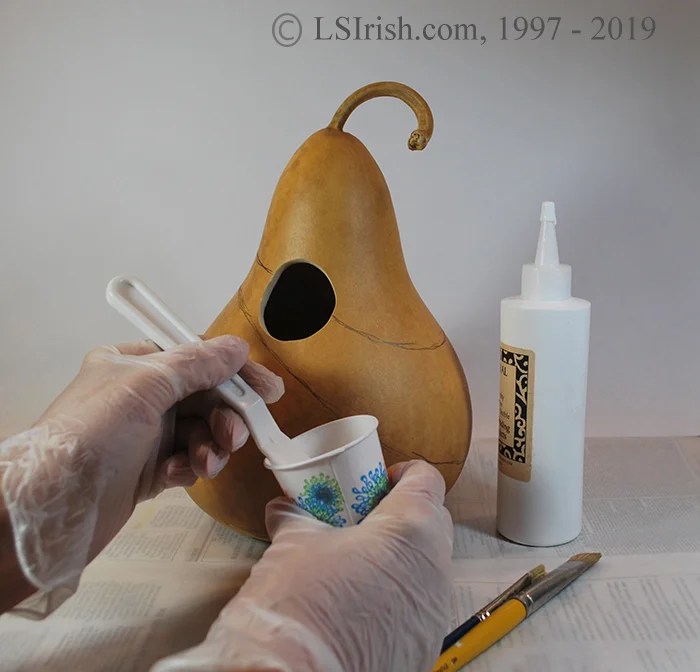
In a wax-coated paper cup mix three tablespoons of archival white water-based glue. Add one tablespoon of water, mix well.
Work the top section with coffee filters.
Work one coffee filter at a time. Dip the filter into clean water, then wring out any the excess water. You want the filter damp, but not dripping.
Step #3 Gluing the coffee filters into place
Apply one coat of glue mix the top section.
With a large square brush, apply one coat of the glue mix to the top section of your gourd. Place the filter onto the glue and press firmly with your brush.
Add more glue if needed. Apply more glue with your brush to the filter as necessary to secure the coffee filter into place. Use the palm of your hand to press the thickest wrinkles into place.
Step #4 Add the cheesecloth
Work the middle section with cheese cloth.
Mix a second batch of archival white water-based glue if necessary. Cut your cheesecloth into small 3” to 4” squares. You can work several overlapping layers of cheesecloth at a time to increase the texture for this area.
Dip the cheesecloth squares in clean water, then blot well on paper towels. Brush a coat of the glue mixture to the central area of the gourd. Place several layers of cheesecloth onto the glued area and use your brush to press it into place.
Step#5 Work the top half of the bottom section with burlap.
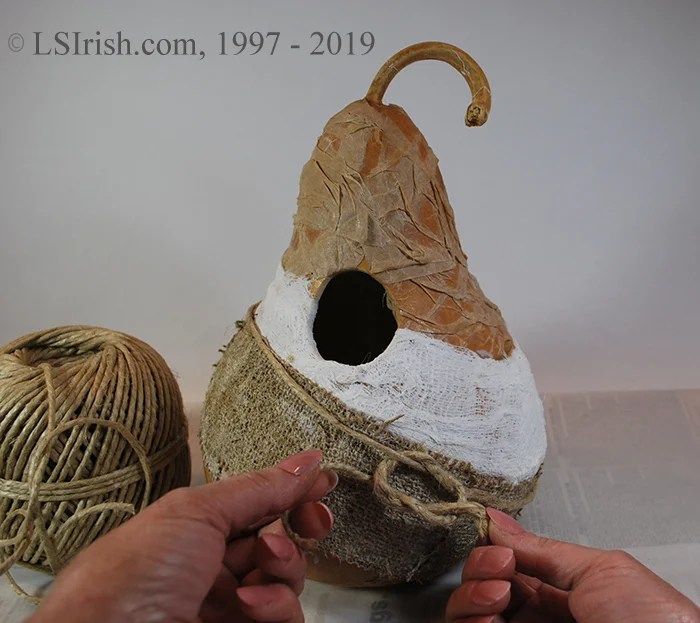
The bottom section of the gourd is covered with 3” squares of burlap. Dampen and blot the burlap pieces on a paper towel. Coat the bottom section of the gourd with your glue mix. Lay one piece of burlap onto the gourd and apply a second coat of glue mix over the burlap. Continue working along the pencil line for this section, overlapping each new burlap piece on the last piece applied. Work just one ring of burlap pieces along the bottom.
Step#6 Leave an area of the gourd un-worked.
Visual contrast is important when you want to artistically emphasize texture. The un-worked bottom area for this bird house gives your eye an area of smooth gourd surface to compare to the textures you have created.
Step #7 Gather a variety of cotton and twin strings.
While you can use just one type of string, using a variety adds to the textured effect of this collage.Cut and tie a string at each intersection of the textures.
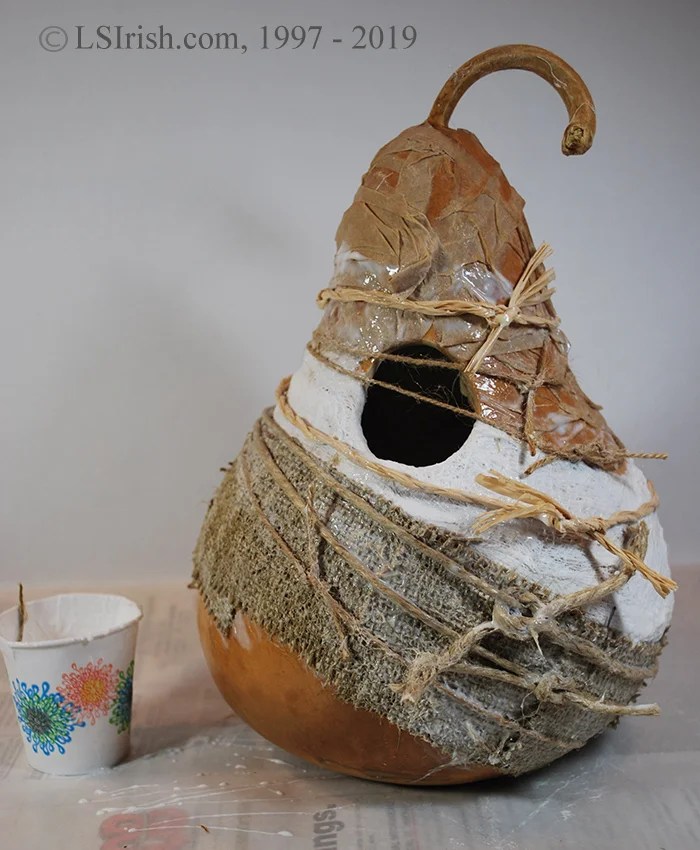
Lay a long piece of twine around your gourd. Move the twin to an intersection between two of your textured areas. Tie a square knot and cut the excess twine from the knot to about 1” long. Brush a generous coat of the glue mix to the twine to hold it into place. The twine wrapping does not have to fall exactly on the joint, let it fall where ever it may.
Let your strings go over the bird house hole as you add then. Glue the string, including that area that is over the hole. After the glue has dried overnight you can cut the small sections of the string that cover the hole without effecting the string at the hole sides.
Step #8 Add one more, even coat of glue mix.
Let your gourd dry for about an hour, then apply one more glue and water mix to all of the textured areas. Dry overnight. Even though the glue is well dried it will have a slightly tacky feeling to the surface. This will diminish with the spray sealer step at the end of the project.
Apply one to two coats of burnt umber brown or black acrylic paint to the entire surface of the decoupaged gourd. This creates a dark background for the color that will lie on the high texture in the next step.
Step #9 Playing with oil pastels.
Oil pastels are ground pigment that is compressed in an oil-based stick. They are available in set that have a full color range.
Using one oil pastel stick at a time, rub your pastel over one of the textured areas. The pastel will adhere to just the highest areas of your texture, leaving the deep areas in the dark brown paint.
Although not shown in this project you can blend oil pastels by laying one color over another lightly. This lets a little of both colors show and creates the new blended color.
You can clean off any pastel color that has gotten into the next area by rubbing the area with your fingers.
Step #10 Apply oil pastel to the strings.
Use contrasting colors for your strings by rubbing the oil stick along the top edge of the string.
Finish this bird house with two to three light coats of spray sealer.
Step #11 Making a wind chime Shown in the top photo
While getting the Monday, January 7th free doodle patterns post ready I came across all of these links on wooden spoon wood burning, and wooden spoon wood carving. Since I had them all in one place I thought I would share them with you.
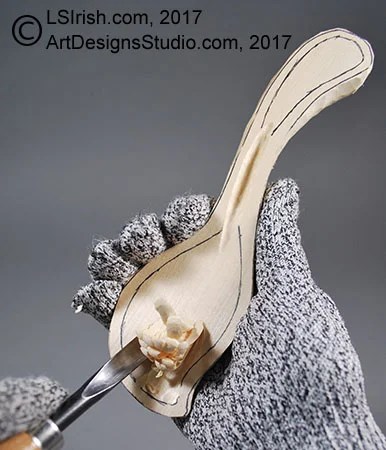
If you wood burn wooden spoons I think you might have some fun learning how to wood carve your own. Basswood blanks are a great wood to start your spoon carving journey. As your carving skills grow you can then move onto poplar, maple, and beechwood – all of which burn well.
If you are a new wood carver there is nothing more fun than creating your own kitchen spoons. Anything goes from the classic straight handle oval-bowled spoon to intrigue Welsh Love spoons, even modern twisted handle pouring ladles. Spoons are one of those ‘guaranteed’ success projects.
Good morning Scot and Marsha! Thanks for the great conversation yesterday. Here are the PDFs that will help you learn how to determine how deep each level or layer is in your relief wood carving.
While today’s blog topic is about levels and layers in relief carving, the same information can help you as a pyrographer determine the shading levels and layers in your wood burning. So, please snatch a copy of the these free PDF files and take time to read through the linked projects here of LSIrish.com.
Free Doodle Patterns, Extra 001
How deep do I cut each level or layer in my pattern in a relief wood carving?
The depth measurement you need for each level or layer in your relief carving depends on several factors.
1. What species of wood are you carving. Hardwoods as black walnut or maple can stand deeper carved levels than soft woods as poplar and basswood. The hardness of the wood – how tightly packed the wood grain rings are – helps to avoid excessive cupping and warping.
2. How thick is your wood blank. You can, of course, carve deeper into a 2″ thick wood blank than you can into a 3/4″ board.
3. How large is your carving blank. A small blank, 8″ x 12″, is less likely to develop excessive warping than a large blank, 20″ x 32″. The longer the grain lines in your blank the more likely they are to cup over time.
Free Doodle Patterns, Extra 004
4. What style of carving will you be doing. A simple round-over edge relief carving can be worked fairly deep into the wood, past the one-half thickness rule of thumb. Since all of the wood grain in a round-over carving is adhered to the wood below it the chances of cupping is reduced. If you are working an intense under-cut relief carving, you will want to stay above the one-half thickness rule of thumb. Undercuts create free hanging shelves of wood that are easily effected by the changes in the wood grain of the entire blank.
General Layer Measurements Rule of Thumb!
In general you want to use the top one-half of the thickness of your wood for your carving area. This leaves one-half of the thickness below the carving to stabilize the board from excessive warping and cupping. So a board that measures a true 1″ thick can be carved to a 1/2″ depth.
In general your pattern will have three distinct layers – foreground, mid-ground, and background. Plus it will have one main focal point – a barn, a duck, a dragon.
Free Doodle Patterns, Extra 005
1. Determine in which layer the main focal points falls as this will become your thickest layer.
2. Divide the carving thickness of the wood blank by 4. This equates to two thickness for the layer that holds your focal point, and one each thickness for the other two layers.
3. So on a 1″ thick board, you will be carving 1/2″ deep. Divide the 1/2″ by 4 equals 1/8″ per layer. That’s 1/8″ for the foreground, mid-ground, and background. Now add the extra 1/8″ to the level or layer that holds the focal point, making it a 1/4″ thick layer.
4. An example is a barn scene where there is a fence line and mail box in t he foreground, a bank barn with silos in the mid-ground, and a tree line and second fence in the background, worked on a 1″ thick board. The focal point of the pattern is the bank barn in the mid-ground level. This equals 1/8″ for the foreground mail box layer, 1/4″ for the bank barn mid-layer, and 1/8″ for the background tree line.
5. The fourth layer or level is called the sky area or sky line. This area of carving is usually extremely shallow, a simple 1/16″ rolled-over edge for mountains and trees, and can be carved on the top surface of the remaining 1/2″ thickness of the wood.








 Crafting With Gourds, by Lora S. Irish


